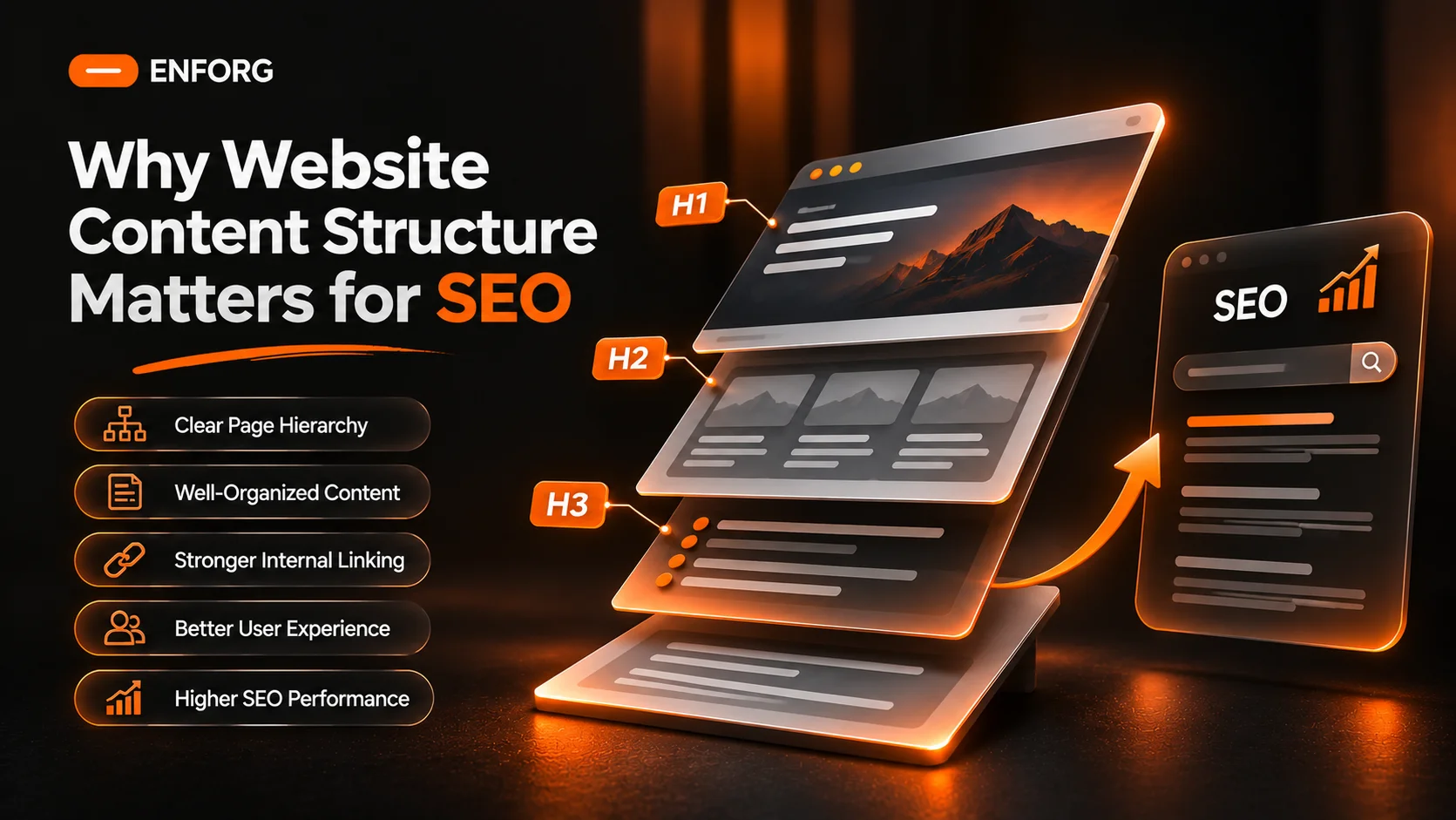
Why Website Content Structure Matters for SEO

Discover why website content structure matters for SEO. Learn how page hierarchy, headings, internal links and organised content improve usability and search engine understanding.
Cover image for the article: Why Website Content Structure Matters for SEO
Article
01
Organise Pages Into a Clear Website Hierarchy
A logical website hierarchy helps visitors and search engines understand how information is organised. Important pages should be easy to access, while related topics should sit within relevant sections. A clear structure connects the homepage to service pages, supporting content and other important resources. This makes navigation more predictable and helps search engines discover how different pages relate to one another.
02
Use Heading Tags to Structure Your Content
Heading tags provide a meaningful outline of each webpage. The H1 should communicate the main topic, while H2 and H3 headings organise supporting sections and subtopics. A logical heading hierarchy makes longer pages easier to scan and helps readers understand how information is connected. Headings should describe the content that follows rather than being selected only for their visual appearance.
03
Create Descriptive and Organised URLs
URL structure helps communicate what a webpage is about. Short, descriptive URLs make page addresses easier to understand and share, while unnecessary parameters and confusing naming patterns can make a website harder to manage. Use relevant words that accurately describe each page and maintain a consistent naming approach across the website. A clear URL structure also supports better organisation as new pages are added.
04
Connect Related Pages With Internal Links
Internal links help visitors discover relevant information without returning to the main navigation every time. They also help search engines find additional pages and understand relationships between related topics. Link service pages to relevant resources, connect supporting blog articles and use descriptive anchor text that explains where the link leads. A thoughtful internal linking structure distributes navigation pathways across the website naturally.
05
Make Content Easy to Read and Understand
Well-organised content improves the experience for visitors who need to find information quickly. Clear paragraphs, descriptive headings and a logical flow make pages easier to scan. Avoid unnecessary repetition, oversized blocks of text and sections that combine unrelated topics. When information is presented in a meaningful order, visitors can understand your services more easily and spend less effort searching for answers.
06
Group Related Topics Into Relevant Content Sections
A website should organise information around meaningful topics rather than publishing disconnected pages. Related services, blog articles and resources can be grouped into relevant categories or sections. This helps establish topical relationships and creates useful navigation paths for visitors. Avoid creating unnecessary categories or multiple pages with overlapping content, as these can make the website harder to understand and maintain.
07
Build a Structure That Supports Search Engine Crawling
Search engines need to discover and access your website's important pages. Clear navigation, sensible internal links, XML sitemaps and a logical page hierarchy support that process. Make sure important pages are not accidentally blocked from crawling or excluded from indexing. A technically accessible structure gives search engines a better opportunity to discover your content, although it does not guarantee rankings or indexing.
08
Review and Improve Your Website Structure Over Time
Website structure should evolve as your business publishes new content and introduces additional services. Review page relationships, outdated URLs, internal links and duplicated information periodically. Use tools such as Google Search Console to identify indexing issues and understand how important pages are performing in search. At ENFORG, our design-first process starts with Figma designs, establishes a fixed price before development and gets design approval before the build begins. Planning content structure early helps create a website that is easier to navigate, maintain and expand.

Your Website Should Move With Your Brand.

A redesign isn’t always about making things look newer. It’s about making your website clearer, more useful and more aligned with where your brand is today.

Enforg Team

Enforg is a web design and development studio in Jaipur, India, founded in 2021. We design in Figma and build in Webflow, Framer, WordPress and Wix Studio. Vetted Pro and Top Rated on Fiverr, with 998+ client projects delivered.

More Ideas. Better Websites.

More thoughts on web design, user experience and building digital experiences that stand out.

How API Integrations Make Business Websites More Powerful

Discover how API integrations make business websites more powerful. Learn how connecting CRMs, payment gateways and external tools improves automation, data exchange and business efficiency.

What Happens During a Professional Website Development Process?

Discover what happens during a professional website development process. Explore project planning, Figma design, development, testing, launch and ongoing support.

Why Your Website Needs a Mobile-First Design Approach

Discover why mobile-first website design matters for modern businesses. Learn how responsive layouts, mobile navigation, performance and usability improve customer experience.